Why Are Cells Small?
Two physical constraints — surface area and diffusion — explain why cells are so small.
A human body is built from 30 trillion cells — excluding microbes — that each arise from a lone, fertilized egg. These cells come in a multiplicity of shapes and sizes, with internal volumes spanning five orders of magnitude. The smallest human cell, a sperm, has a volume of just 30 µm³, whereas an oocyte has a volume of 4,000,000 µm³, making it the largest cell in the human body.1
What accounts for this huge range? A simplistic answer is that evolution has made each cell the size best suited to its function. Maybe sperm are small because the body needs to make many of them, and tiny cells cost less energy to make. (Sperm consist of little more than DNA and a few mitochondria, which are necessary for providing energy to spin their whip-like tails.) By contrast, an oocyte needs massive reserves of mitochondria and nutrients to support early embryonic growth. In short, every cell is as large or small as it needs to be — within reason.
But we can derive far more satisfying answers from physics.
The first major limit on a cell’s size is its surface area-to-volume ratio. Assuming that a cell is roughly spherical in shape, its internal volume grows proportionally to the cube of its radius, whereas its surface area grows proportionally to the square of that radius. In other words, a cell’s volume grows much faster than its surface area.
This ratio has big consequences for cell survival. The cell’s membrane funnels nutrients into the cell and secretes waste. It’s also where the energy in a prokaryotic cell — like E. coli — gets made. If the interior grows too large relative to the membrane, the cell will not be able to produce enough energy or excrete waste quickly enough to maintain all the ‘stuff’ inside, and metabolism will slow down.
A second constraint is diffusion, or the tendency for molecules to migrate from areas of high concentration to areas of lower concentration. This migration dictates how quickly enzymes find substrates, or how signaling molecules reach receptors, and how often ribosomes collide with messenger RNAs. Inside a cell, nearly everything happens by chance encounters amongst molecules! As a cell’s volume grows, though, the chance that these encounters will happen decreases (assuming the total numbers of molecules stay constant).2
A molecule’s diffusion rate changes based on various factors. The cytoplasm is extremely crowded, for example, and so molecules spend lots of time ricocheting off obstacles, delaying their arrival at a distant location. Every protein in a cell collides with about 10 billion water molecules per second on average. The vast majority of proteins in a bacterium have diffusion coefficients of only 5 to 10 µm2 per second (a measure of how quickly molecules spread through space). Some molecules also aggregate or stick to charged surfaces, further slowing their movement.3 In general, large molecules diffuse slower than small ones.
Metabolites in E. coli can diffuse from one side of the cell to the other in milliseconds, which means collisions — and cellular outcomes — happen quickly. A typical protein takes just 0.01 seconds to traverse a bacterium’s diameter (about 1 micrometer), but the same protein would take around four minutes to move one millimeter and more than six hours to move one centimeter. This is, in part, why cells are so tiny.
With these constraints in mind, we can begin to speculate as to why various cells are shaped the way they are.
Red blood cells are tiny and shaped like biconcave discs to aid with diffusion; by abandoning a spherical shape and evolving more toward a ‘donut,’ they increase their surface area without compromising their compact volume. This, in turn, enhances their ability to exchange oxygen with cells in the body. Their small size (just 8 micrometers across) also helps them move through narrow capillaries.
In contrast, oocytes can grow so large, in part, because they are less metabolically active than other types of human cells — and thus don’t depend so much on random collisions. They stockpile nutrients during oogenesis to wait out fertilization. Eukaryotic cells also grow large, in general, because they’ve evolved compartmentalization; by modularizing specific functions into organelles, they bring molecules closer together to help get the job done.
Cell sizes are not fixed, however, even within a single species. Cells often swell as they increase their production of proteins and metabolites in preparation for division. This is in line with biology’s only rule: namely, there are exceptions to every rule!
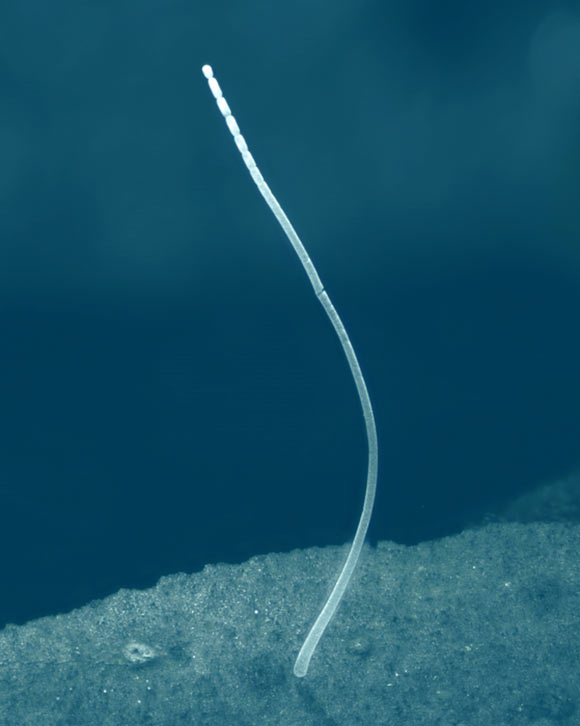
Case in point: a giant bacterium called Thiomargarita magnifica can extend about one centimeter in length, so large that it can be seen by the naked eye. It does so by breaking the surface area-to-volume rule, filling between 65–80 percent of its internal volume with an empty vacuole. In other words, it pushes most of its molecules to the cell periphery, thus shortening diffusion distances.4
Despite their variety, these architectures still hinge on molecules bumping into each other, guided by the immutable laws of physics. Or, as D’Arcy Wentworth Thompson mused in On Growth and Form (1917), “The form of an object is a ‘diagram of forces.’” Cells bear witness to both internal and external forces; they are constrained by diffusion and shaped by the delicate trade-off between volume and surface area.
Notes
- ↑ In other words, the egg is more than 100,000-times larger than the sperm that swims to it. But it’s difficult to wrap our heads around such large numbers, and so it’s often helpful to rescale entities into everyday objects that we can more easily imagine. If a sperm cell were ‘blown up’ to the size of a glass marble, for example, then an oocyte, scaled in the same way, would be roughly the size of a modern refrigerator.
- ↑ Obviously, this assumption is not true. As cells grow, they make more molecules to keep collision times low. But it costs energy to make more molecules, and this is a tradeoff I return to below.
- ↑ Several experiments have shown that molecules move more slowly near the densely-packed nucleoid, for example, and that these location-dependent diffusion rates are affected by things like charges between proteins.
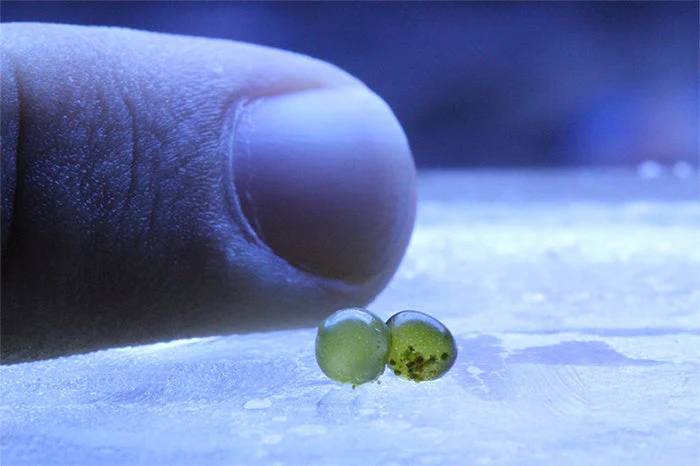
- ↑ So-called ‘bubble algae,’ or sea grapes, do something similar. They are the largest single-celled organism, up to 10,000-times larger than an average microbe (and visible to the naked eye!) The bubble algae achieve this by filling up 95% of their internal volume with a vacuole. The vacuole is filled with big sugar chains, which the cell uses to repair damage on its cell extremities. Each cell also has dozens or hundreds of nuclei, pressed tightly against the walls.
Feedback
Please send corrections and questions to nsmccarty3@gmail.com. I update these essays based on your feedback. If you send a comment that improves the essay, I'll publish your name on this website and in a forthcoming book.
This essay was improved by:
— A., Ben Andrew, Ashish Uppala